Sante Kotturi · November 2026 · one person, 137 paired nights
TL;DR
- Ultra 2, Series 11 or earlier: if you want recovery HRV, get a Fitbit Air and sync it into Apple Health. These watches check HRV about four times a night. The Fitbit checks every five minutes, and its nightly number is far more repeatable.
- You can then leave that Watch off at night. The Fitbit covers sleep, heart rate and HRV.
- Ultra 4 or Series 12: the Fitbit adds nothing for HRV. The watch now measures as often as the Fitbit, and over 48 nights the two tracked each other almost exactly.
I started wearing a Fitbit Air to bed in June to augment my Apple Watch Ultra 2. The Fitbit measures HRV every five minutes through the night. The Ultra 2 measured it about four times. Then in September the Ultra 4 came out, and it basically matched the Fitbit.
Both devices' data sits in Apple Health. The Fitbit's gets there through Airlift, an app I wrote to bridge it, described in section 3. That gave me 137 nights with both worn, 89 with the Ultra 2 and 48 with the Ultra 4. The numbers:
- Nightly HRV. The Ultra 2 took about 4 HRV readings a night. Its nightly number agreed with the Fitbit at Spearman ρ = 0.54 using Apple's published values, and 0.69 after I rebuilt RMSSD from the raw heartbeats. The Ultra 4 takes about 95 readings a night and agrees at ρ = 0.94 (95% CI 0.90 to 0.97).
- The cause is how often the watch measures. Thinning the Ultra 4 back to 4 random readings a night drops it to ρ = 0.62, which is where the Ultra 2 was.
- The two devices disagree on level by a steady amount. The Ultra 4 reads 28% higher than the Fitbit, and that ratio varies by only 5% from night to night.
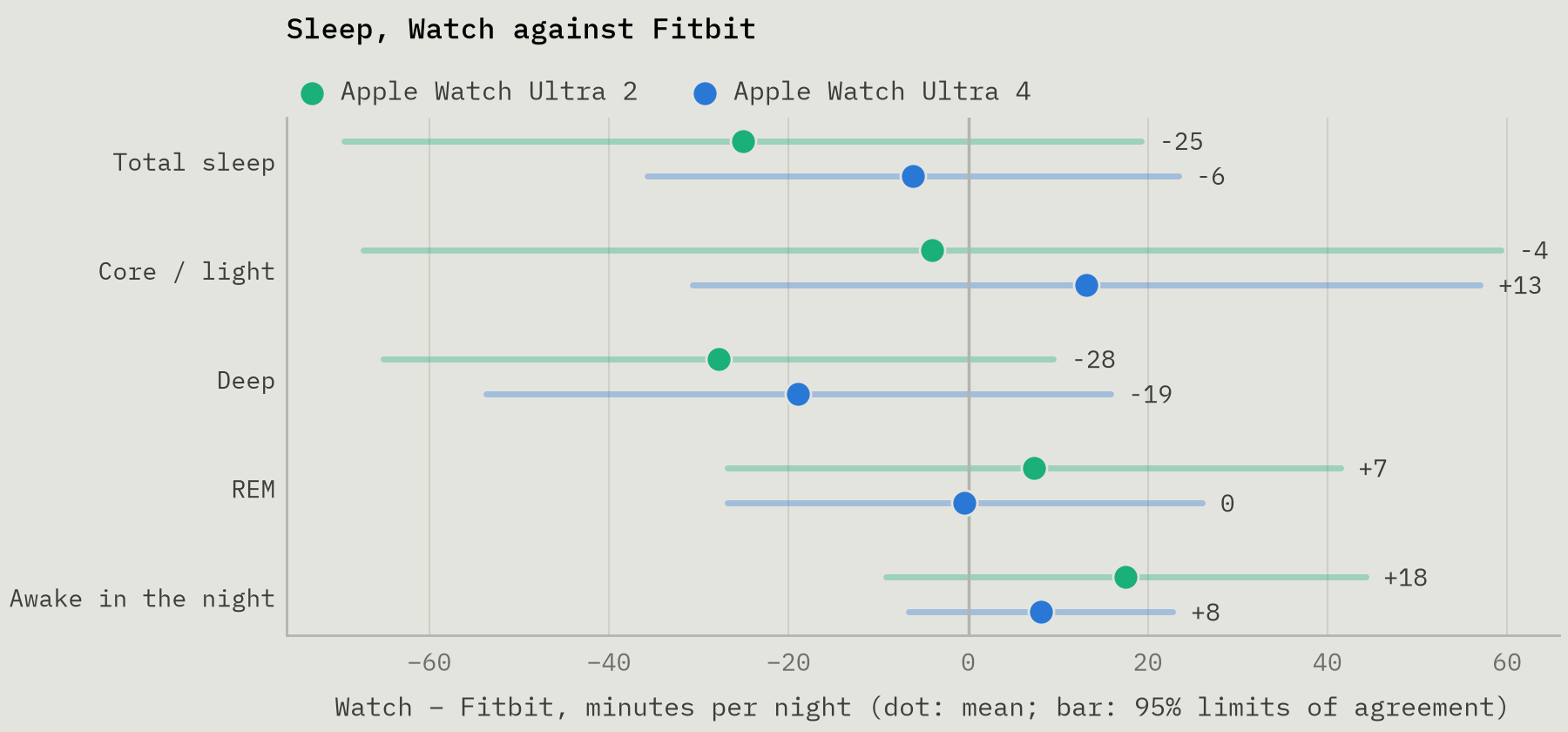
- Sleep. The devices agree on 80% (Ultra 2) and 82% (Ultra 4) of 30-second epochs. The Ultra 2 logged 25 minutes less sleep a night than the Fitbit; the Ultra 4 logs 6 minutes less. Deep sleep is where they disagree most.
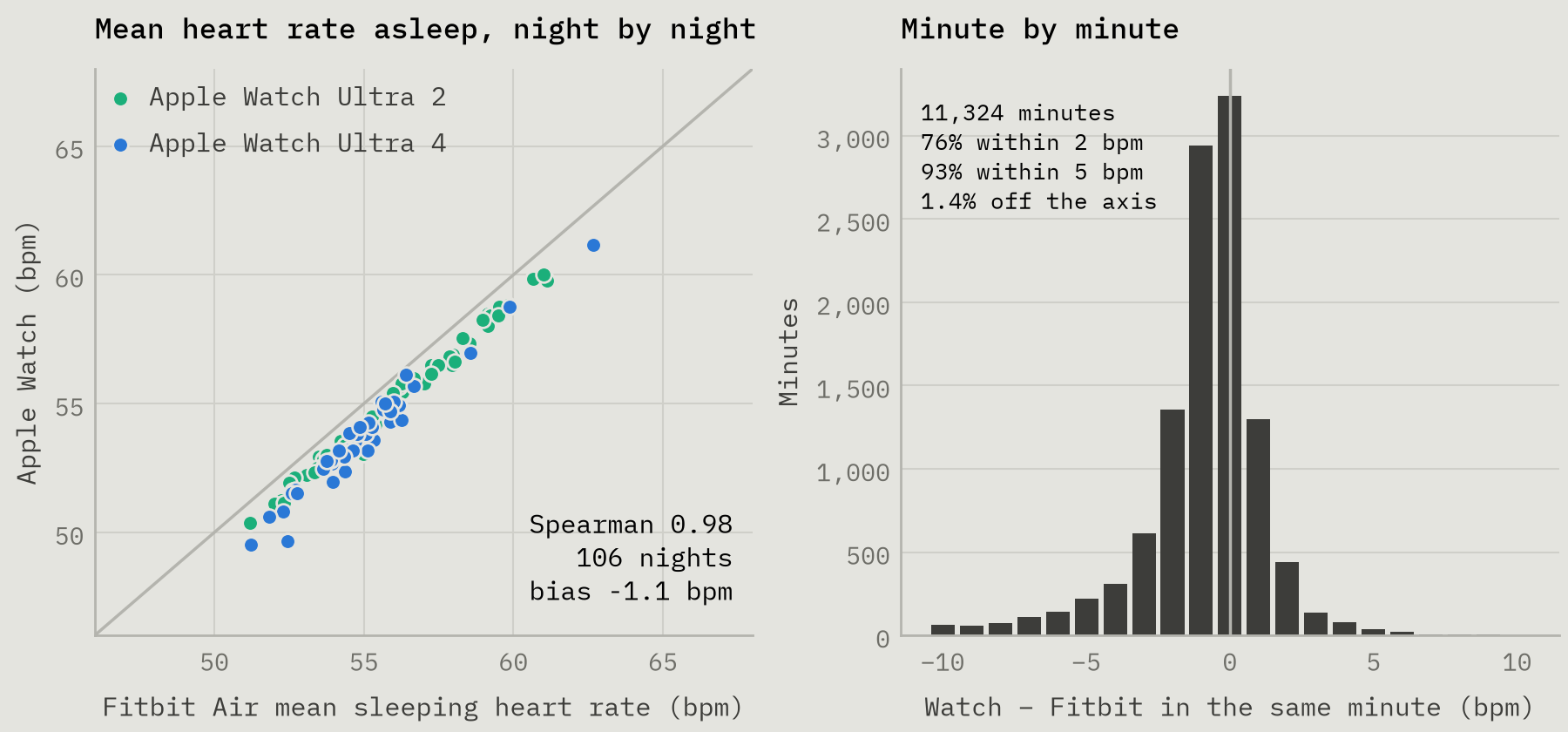
- Heart rate. Mean sleeping heart rate differs by about 1 bpm on average, and by less than 3 bpm on every night measured.
This is one person. The Fitbit is a second consumer device, not a lab reference, so everything here is agreement between two wearables and not accuracy.
1. Data and method
I had written up an early version of this comparison in August, on 37 nights with the Ultra 2. This is the longer run, with the watch upgrade in the middle.
Data
| Ultra 2 period | Ultra 4 period | |
|---|---|---|
| Nights (evening of) | 5 Jun to 9 Sep | 23 Sep to 11 Nov |
| Nights with both devices' sleep | 89 | 48 |
| ...with HRV from both | 71 | 48 |
| ...with heart rate from both | 59 | 47 |
| Mean shared sleep window | 7.9 h | 7.9 h |
The export was taken on 12 November: 7.2 million records, of which 1.57 million were kept (heart rate, HRV, sleep, breathing, SpO₂), plus 675,000 individual heartbeats attached to the Watch's spot checks.
Method
- Nights. Each device's sleep stages are grouped into sessions, and the longest session of at least three hours is that device's night.
- Shared window. Both devices are scored inside the stretch that both call sleep. A difference in HRV then cannot be a difference in bedtime.
- Nightly HRV. The Fitbit's value is the mean of its five-minute RMSSD readings. The Ultra 4's is the mean of its own five-minute RMSSD readings. The Ultra 2 has two versions: the mean of Apple's published SDNN spot checks, and RMSSD recomputed from the stored heartbeats, artifact-corrected and pooled across the night.
- Agreement. Spearman ρ across nights, with a Fisher interval. Agreement on changes is the Spearman ρ of consecutive-night differences on the log scale. Bias and 95% limits of agreement follow Bland and Altman. HRV ratios are computed on logs.
- Reliability. Each night's readings are split at random into two halves, each half is averaged, and the halves are correlated across nights, then corrected with the Spearman-Brown formula. This is repeated 300 times.
- Sleep epochs. Both hypnograms are cut into 30-second epochs over the span both devices cover, and compared epoch by epoch.
The analysis code is Python: a streaming parser for the export, and a small library of agreement statistics.
2. Results
2.1 How often each device measures
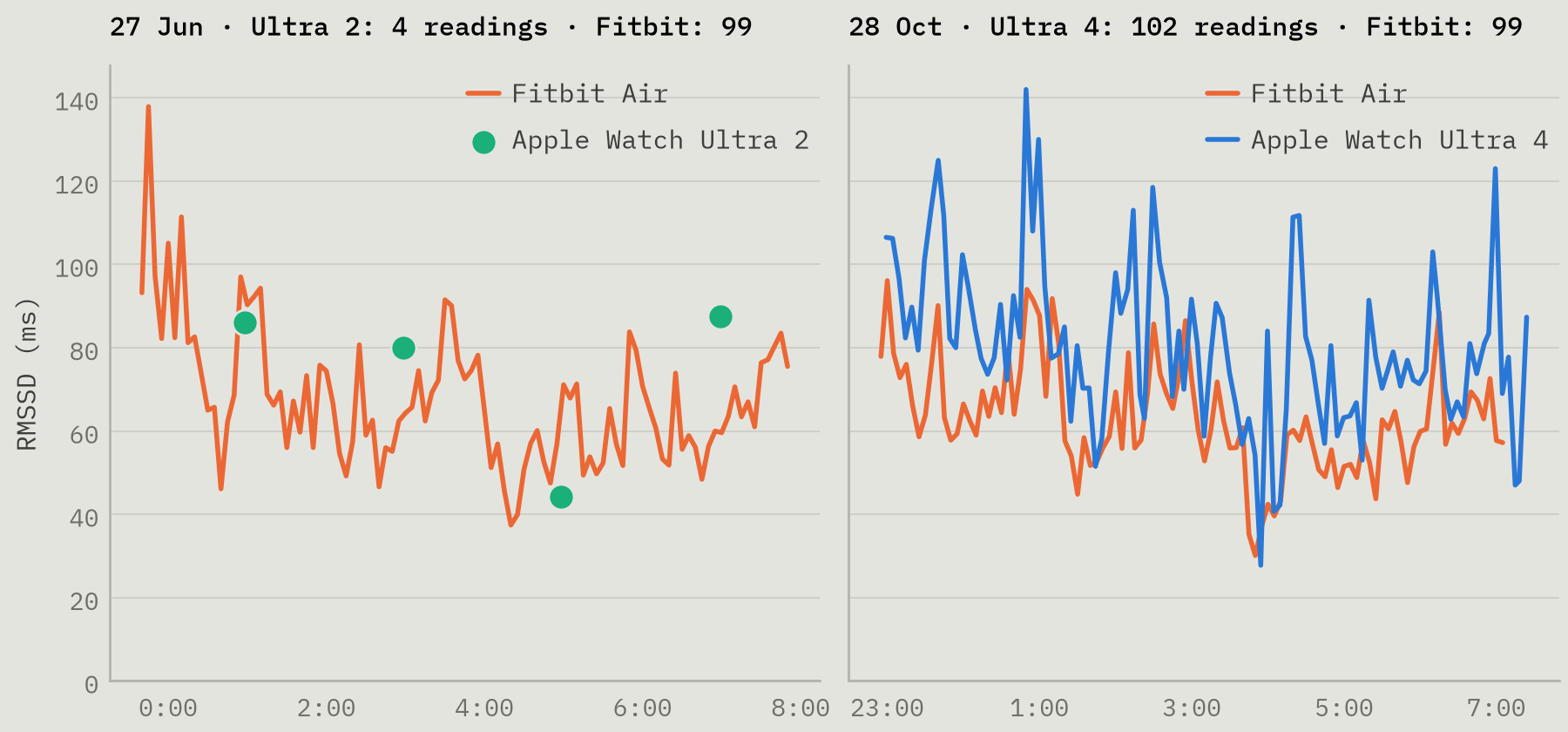
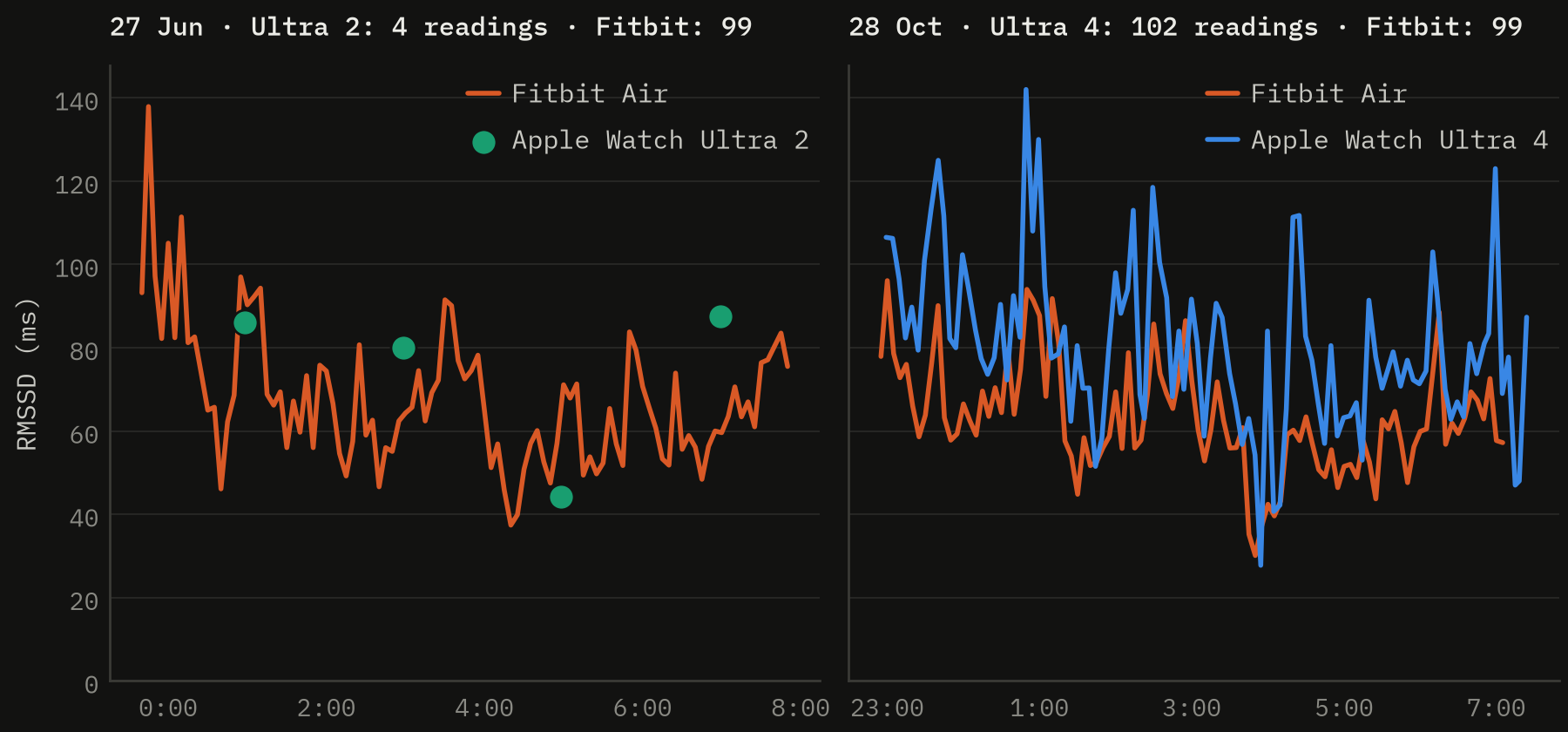
HRV swings widely inside a single night. A watch that samples it four times catches four arbitrary moments, which is why the Ultra 2's nightly number jumped around so much from one night to the next.
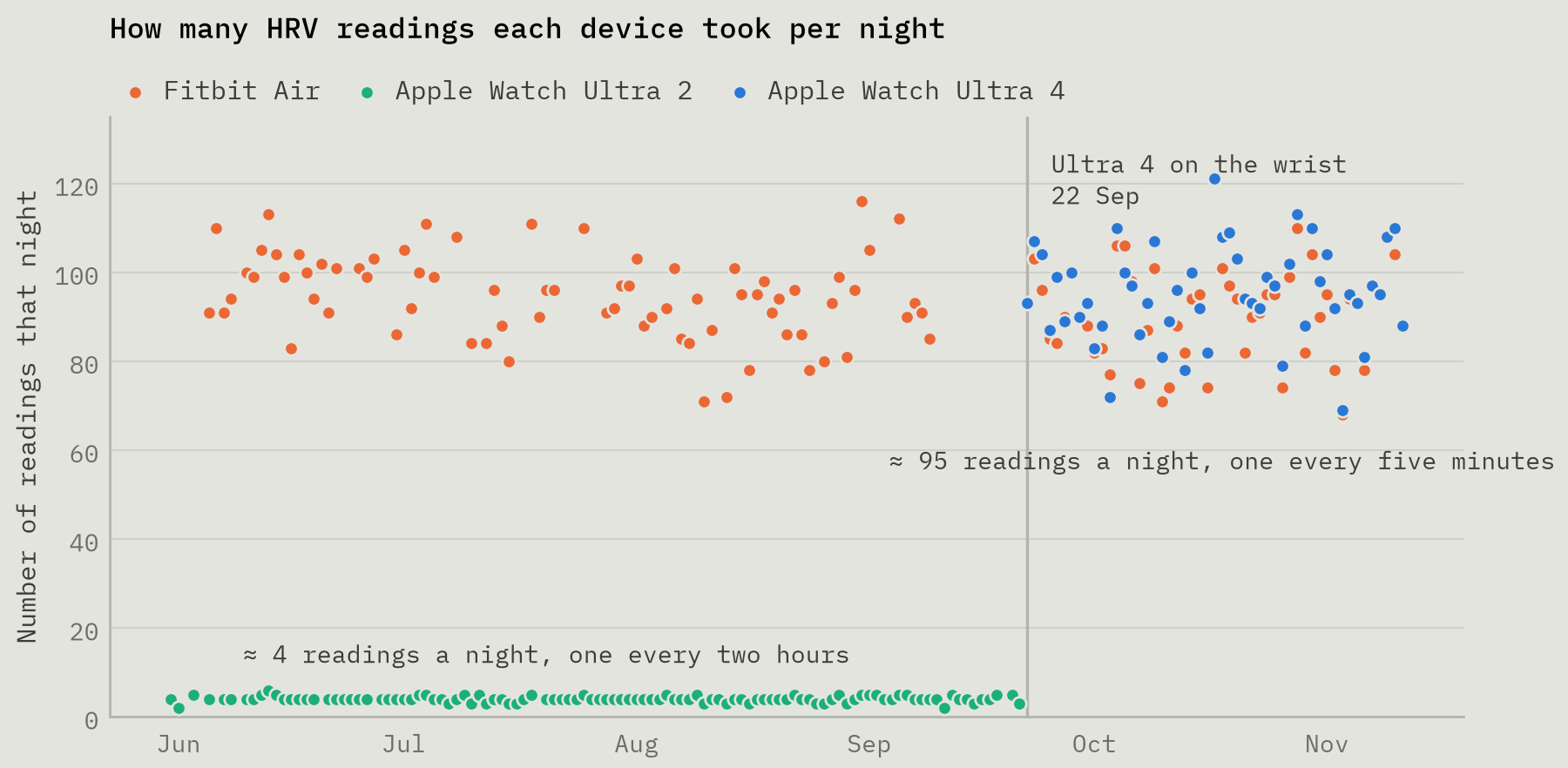
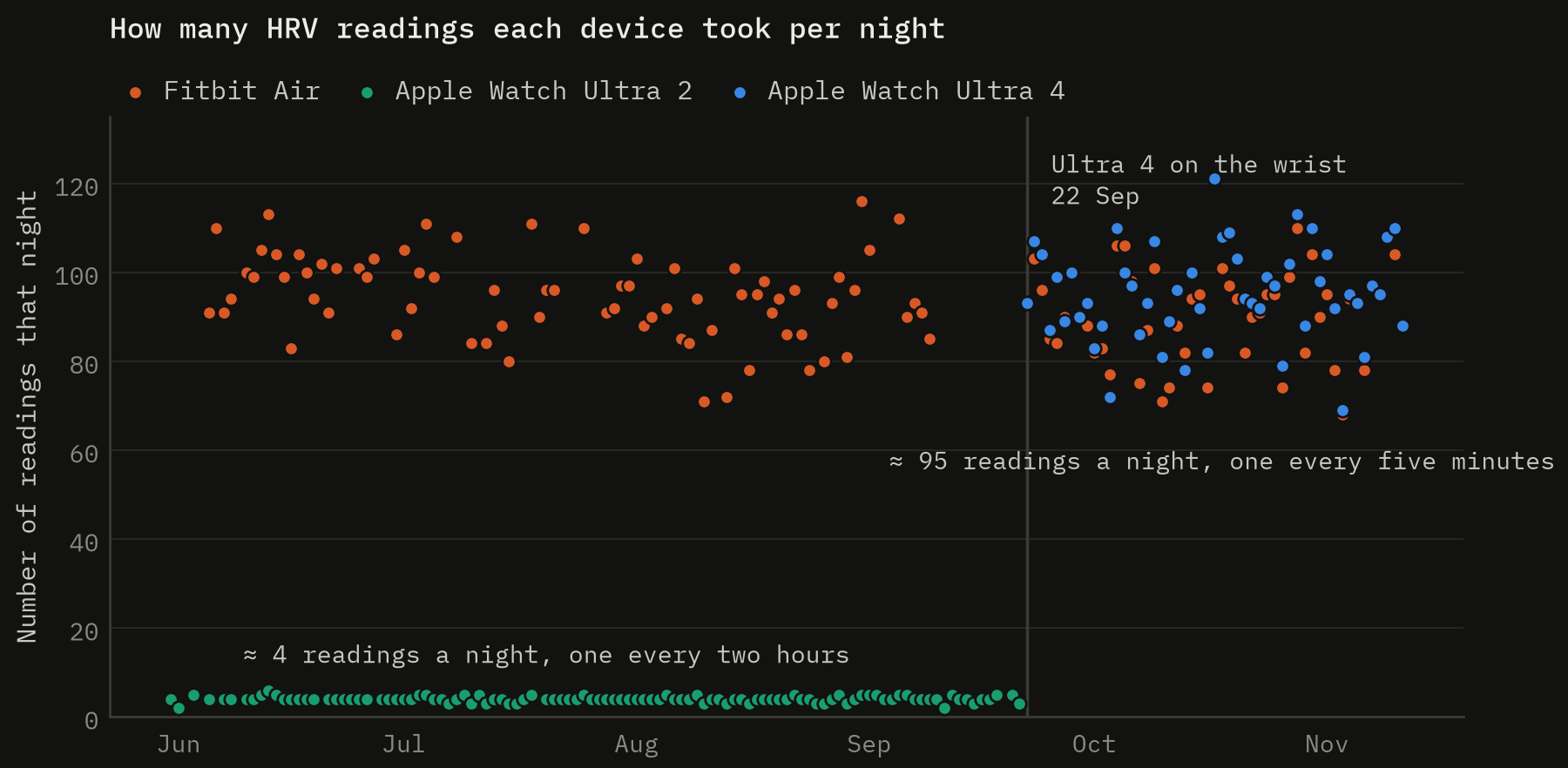
| Device | HRV readings per night | Spacing | Window |
|---|---|---|---|
| Fitbit Air | 92 | 5 min | 5 min |
| Apple Watch Ultra 2 | 4 | 2 h | about 1 min |
| Apple Watch Ultra 4 | 95 | 5 min | 5 min |
The Ultra 4 still takes the old two-hourly spot checks as well, about 4 a night, with heartbeats attached. That turns out to be useful in section 2.3.
Heart rate did not change. Both watches stored about 110 heart-rate samples in a night's sleep.
2.2 Nightly HRV
| Watch metric | Nights | ρ levels | ρ changes | Offset |
|---|---|---|---|---|
| Ultra 2 · Apple SDNN | 71 | 0.54 | 0.45 | n/a |
| Ultra 2 · reconstructed RMSSD | 71 | 0.69 | 0.64 | +11% |
| Ultra 4 · spot-check RMSSD | 48 | 0.67 | 0.65 | +3% |
| Ultra 4 · native RMSSD | 48 | 0.94 | 0.95 | +28% |
ρ is Spearman's rank correlation with the Fitbit's nightly RMSSD. The 95% intervals on the level correlations are, in row order, 0.35 to 0.69, 0.55 to 0.80, 0.48 to 0.80 and 0.90 to 0.97. "Reconstructed RMSSD" is RMSSD I recomputed from the heartbeats stored with each spot check. Offset is how far the Watch reads above the Fitbit. SDNN is a different statistic, so it has no meaningful offset.
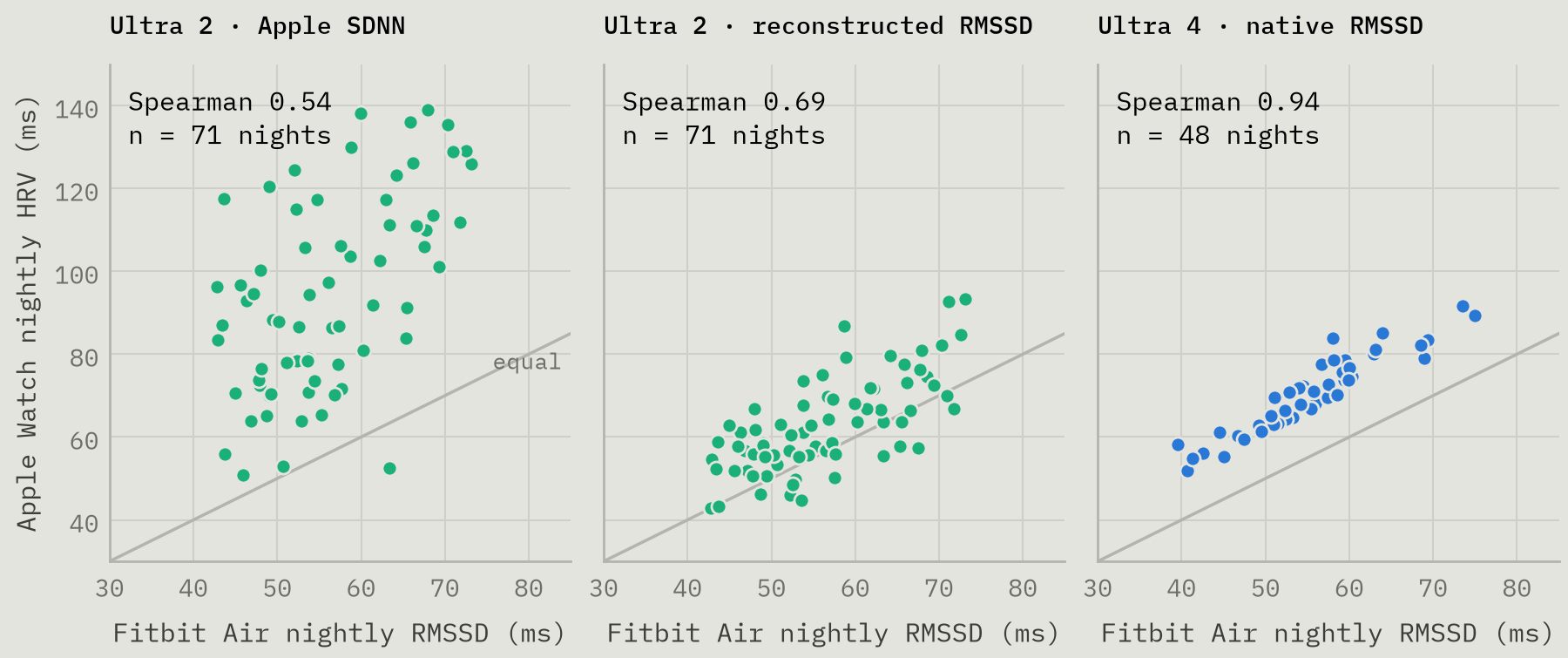
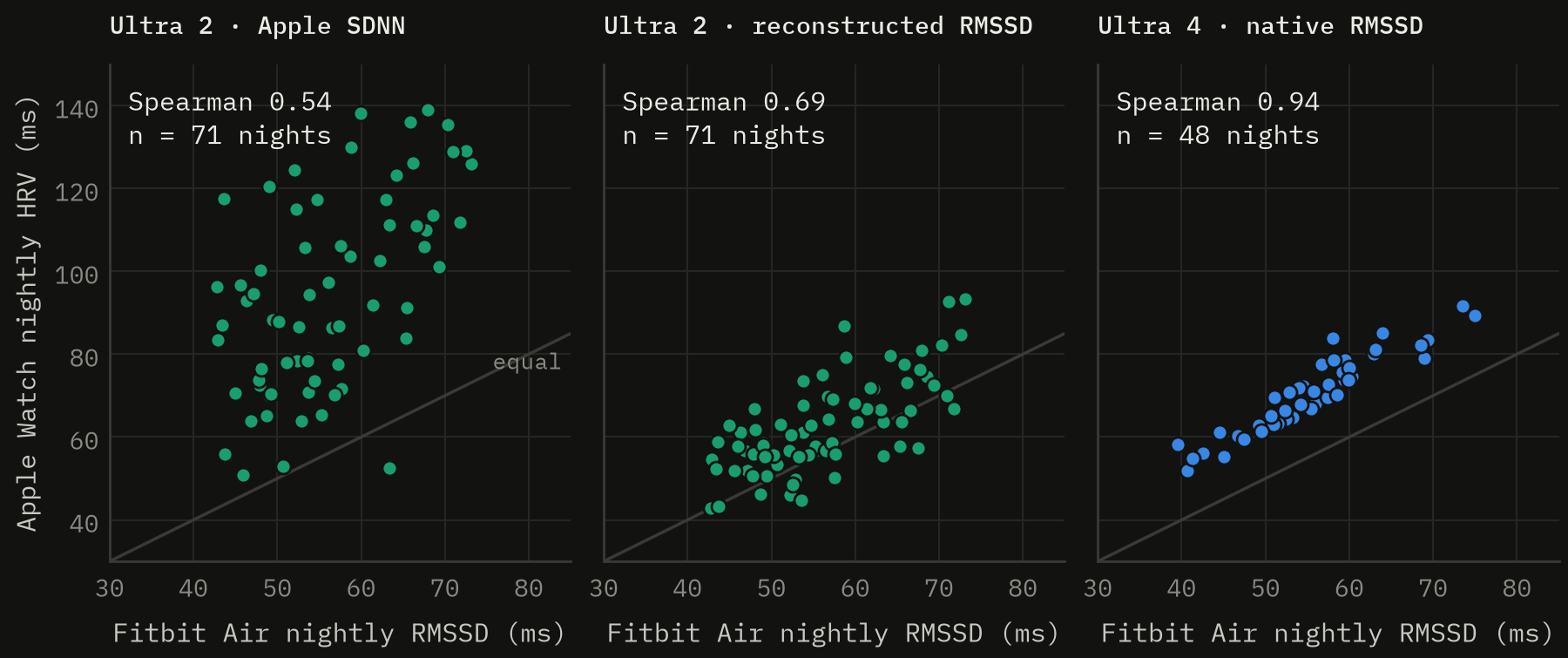
The gap between the Ultra 4's native series and the best Ultra 2 pipeline is not a small-sample accident (Fisher z = 4.8, p < 0.001). The Fitbit's own level did not move between the two periods (56.2 against 55.3 ms, Mann-Whitney p = 0.68), so the reference stayed where it was.
Agreement on changes matters more than agreement on levels, because a recovery score is a statement about last night compared with your usual. On that measure the Ultra 2's published number reached 0.45. The Ultra 4 reaches 0.95.
The offset. The two devices do not read the same value. The Ultra 4 averages 70 ms where the Fitbit averages 55 ms: a bias of +15.1 ms, with 95% limits of agreement from +8.6 to +21.6 ms. As a ratio the Watch reads 28% high, and that ratio has a night-to-night spread of 5%. It showed no drift over the seven weeks (ρ = 0.10 against date, p = 0.50). Once the ratio is divided out, the two devices differ by 2.2 ms a night on average.
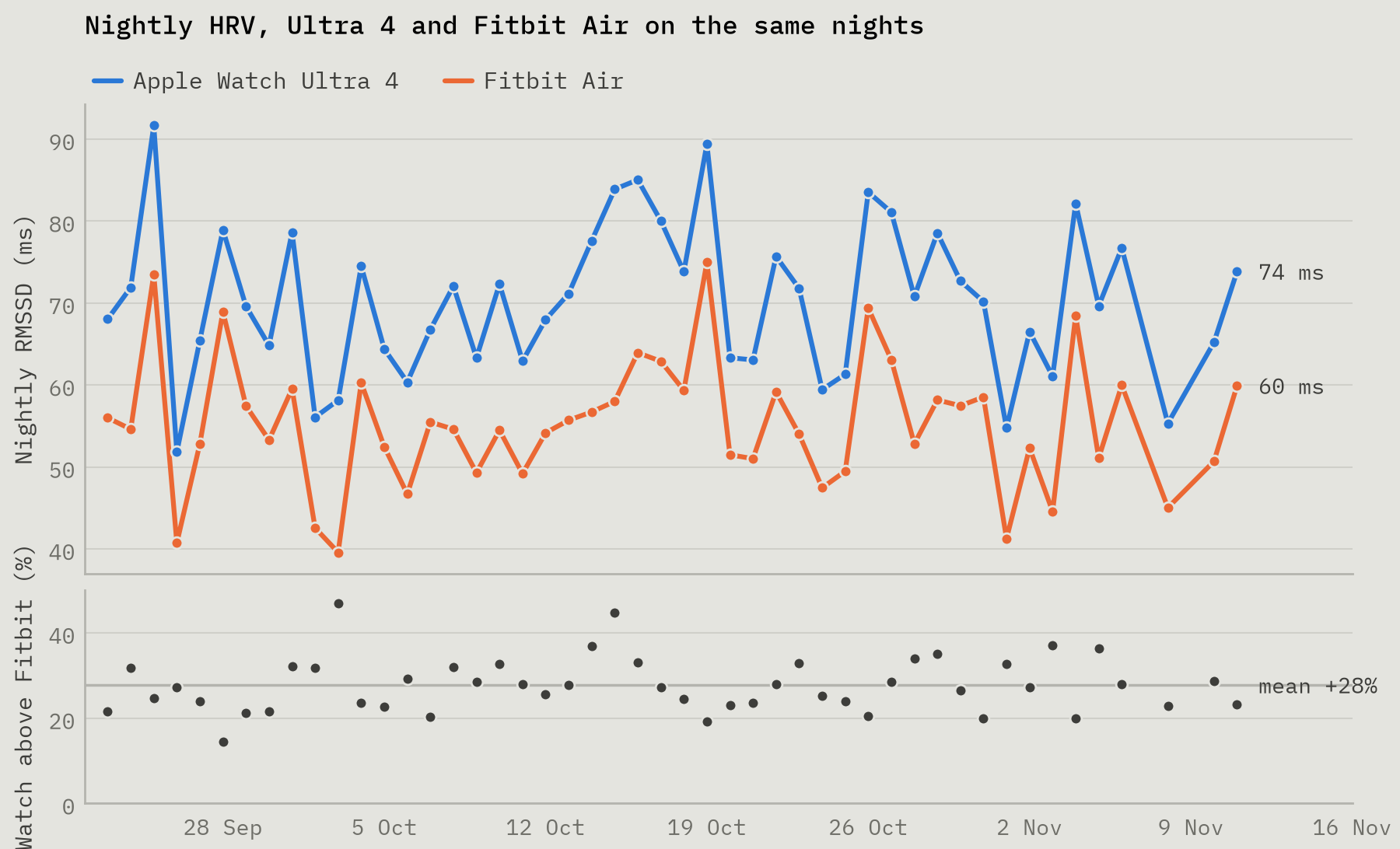
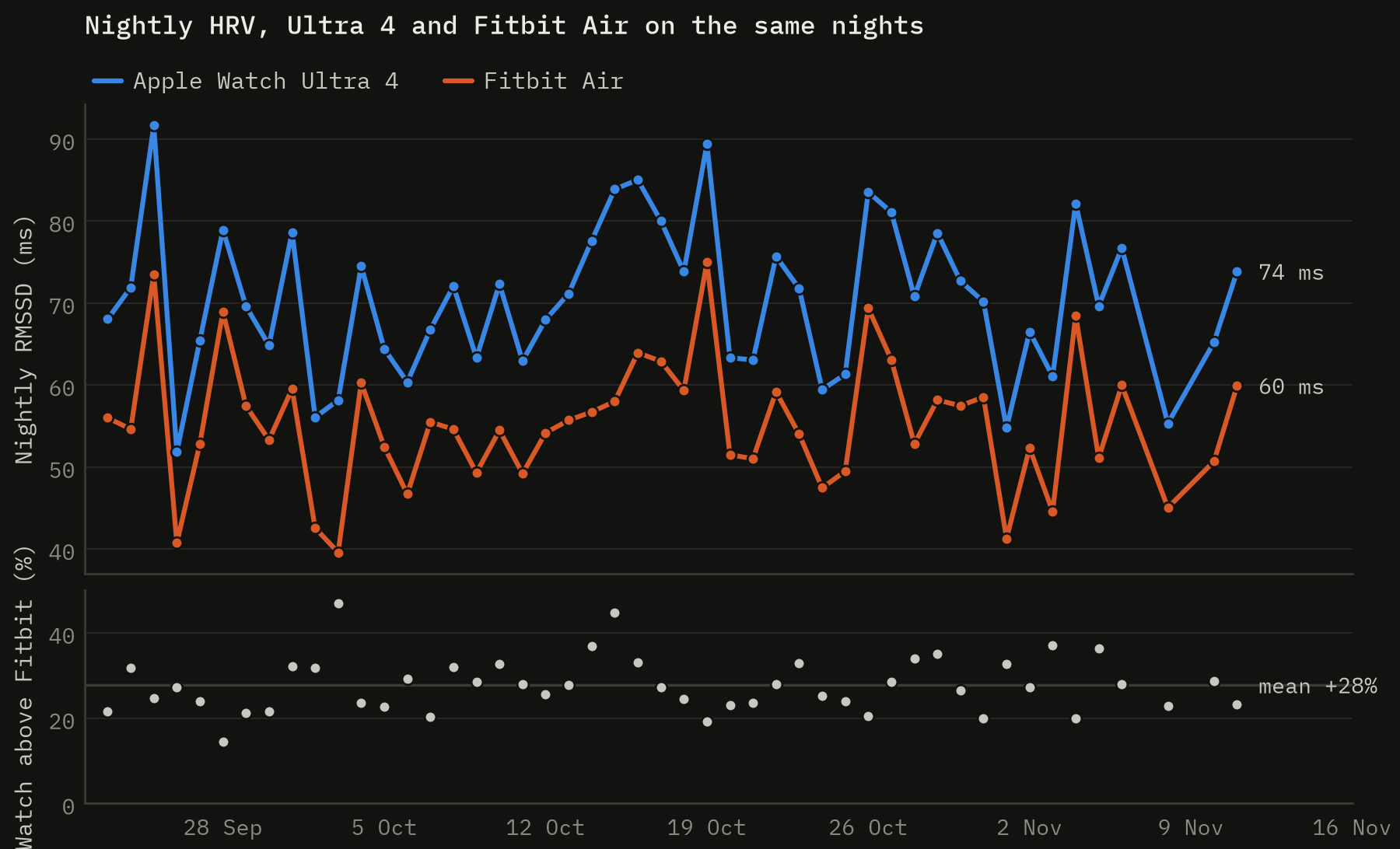
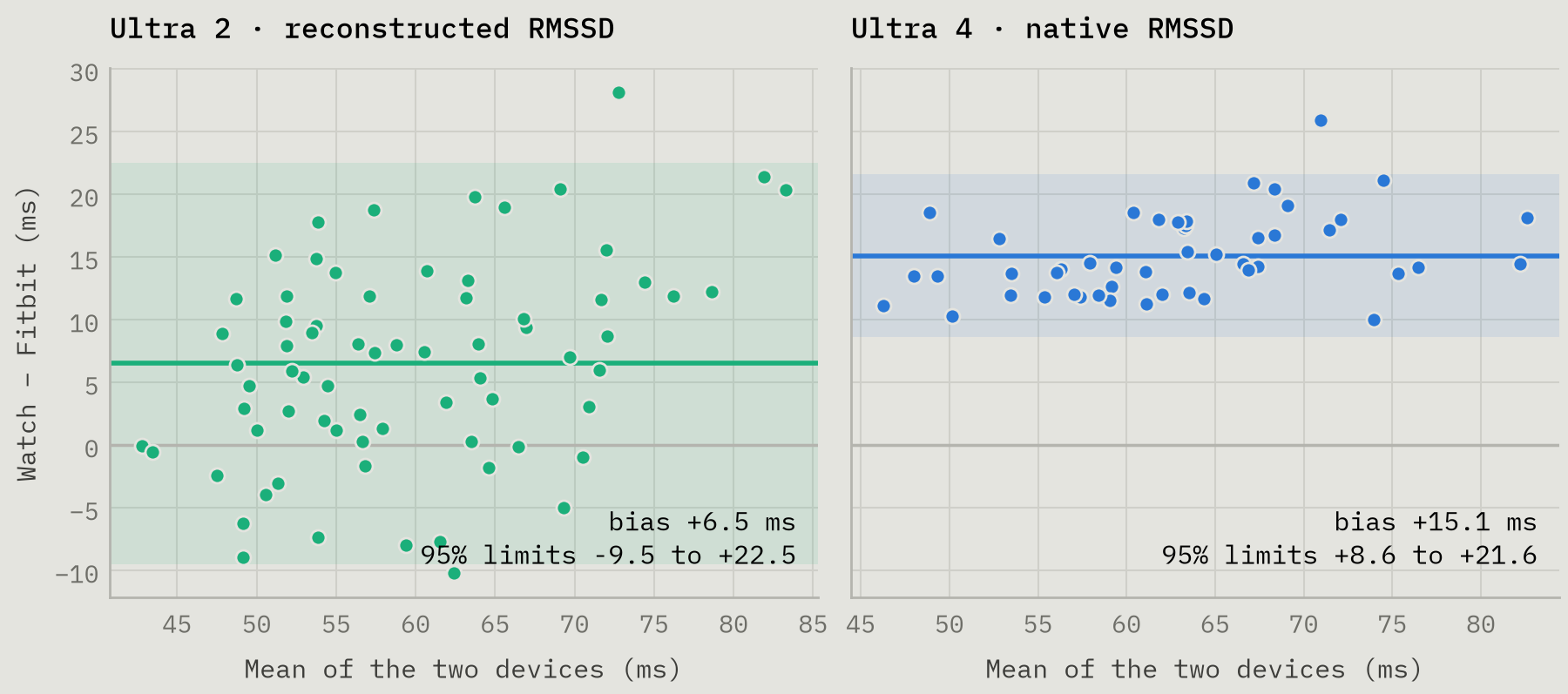
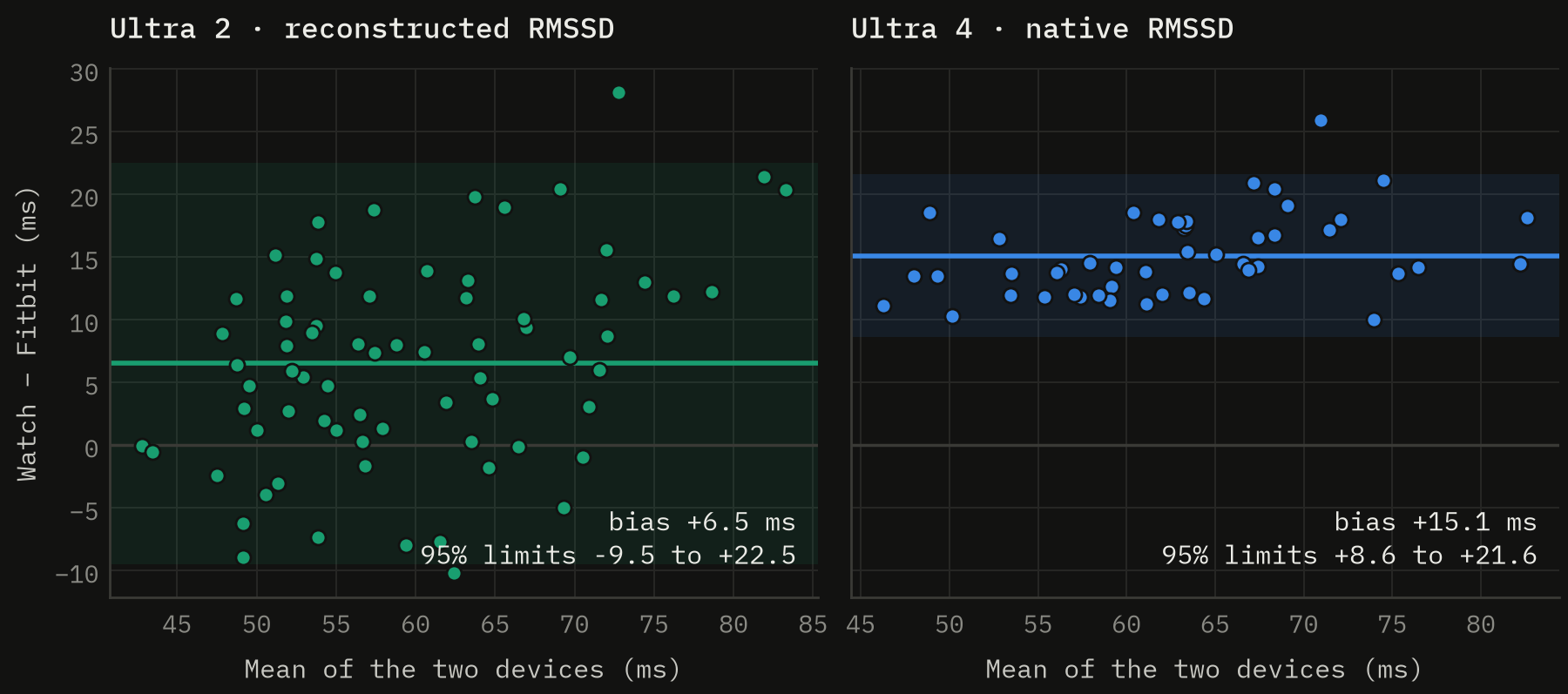
Inside a night, the agreement is looser. Across 4,033 five-minute windows where both devices have a reading, the correlation is 0.68, and within a single night the median is 0.60. The Watch's excess is smaller in deep sleep (+15%) than in core (+25%) or REM (+27%). So the nightly averages agree far better than the individual readings do. Averaging 95 readings is what does it.
2.3 Sensor or schedule?
The Ultra 4 has a new sensor and a new schedule, and either could explain the jump. Two checks separate them.
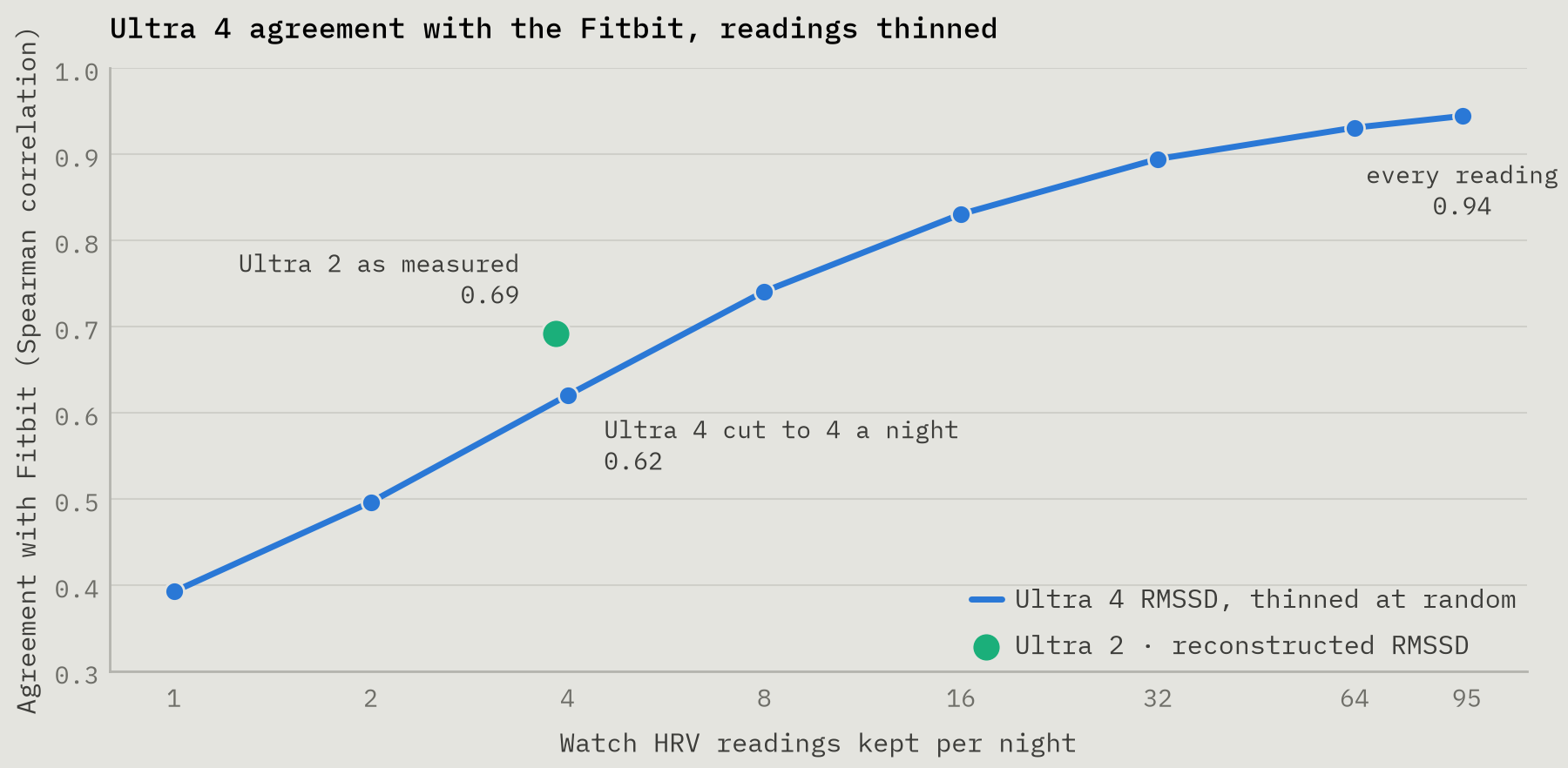
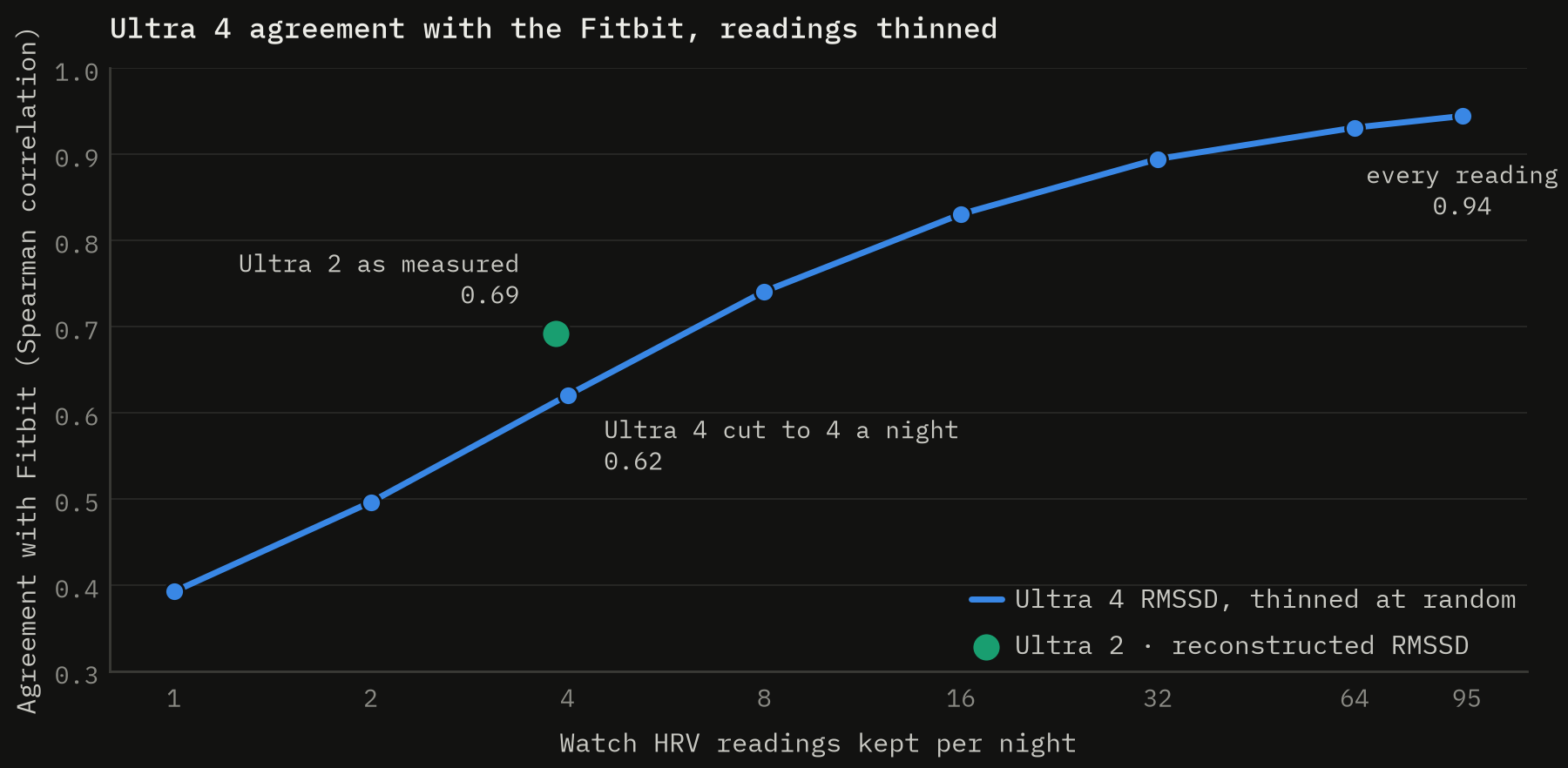
First, I threw away the Ultra 4's readings at random until only k a night were left, and scored what remained against the Fitbit.
| Readings kept per night | ρ against Fitbit |
|---|---|
| 1 | 0.39 |
| 2 | 0.50 |
| 4 | 0.62 |
| 8 | 0.74 |
| 16 | 0.83 |
| 32 | 0.89 |
| 64 | 0.93 |
| all (about 95) | 0.94 |
At 4 readings a night the Ultra 4 scores 0.62. Keeping one reading every two hours, the old schedule, gives 0.67. The Ultra 2 scored 0.69 with the same number of readings.
Second, the Ultra 4 still takes the old spot checks. Rebuilt into RMSSD the same way as the Ultra 2's, they score 0.67 against the Fitbit, on the same nights and the same wrist where the dense series scores 0.94.
Both checks point the same way. The improvement comes from measuring 24 times as often. Whatever the new sensor contributes, a watch that measures HRV four times a night lands near 0.65, and this was true of both generations.
2.4 How repeatable each number is
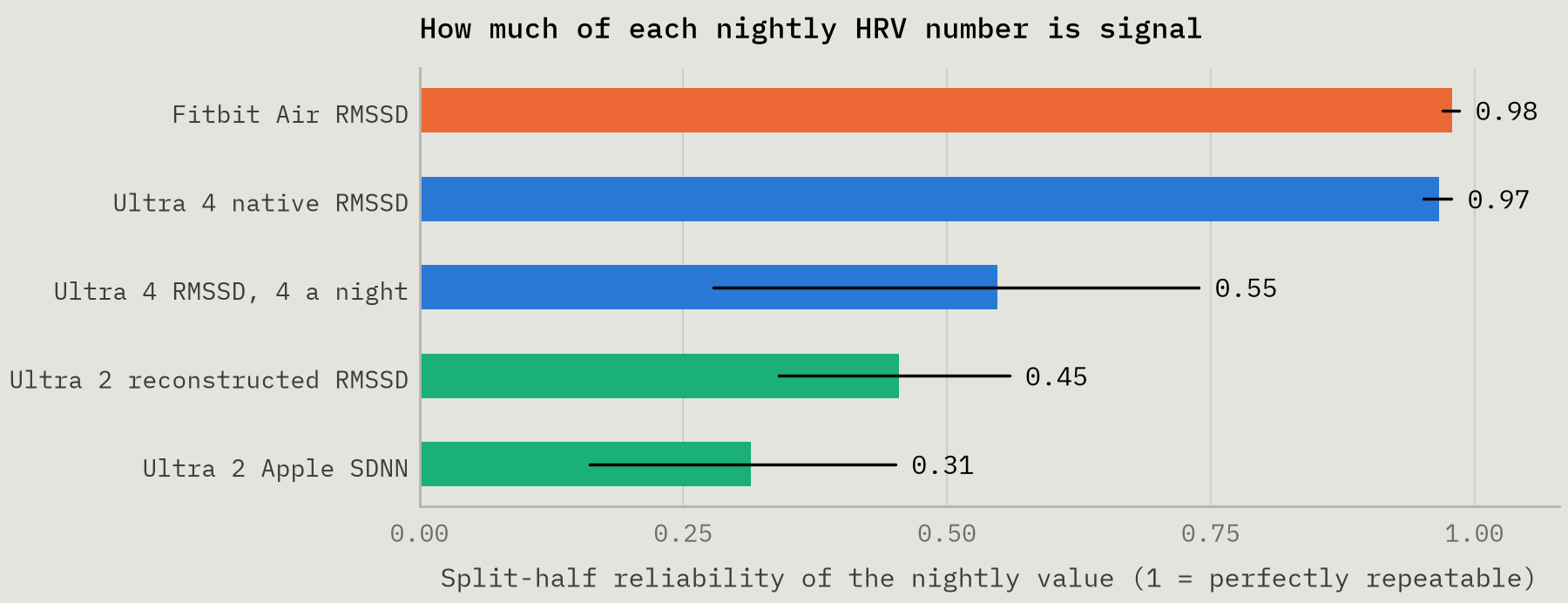
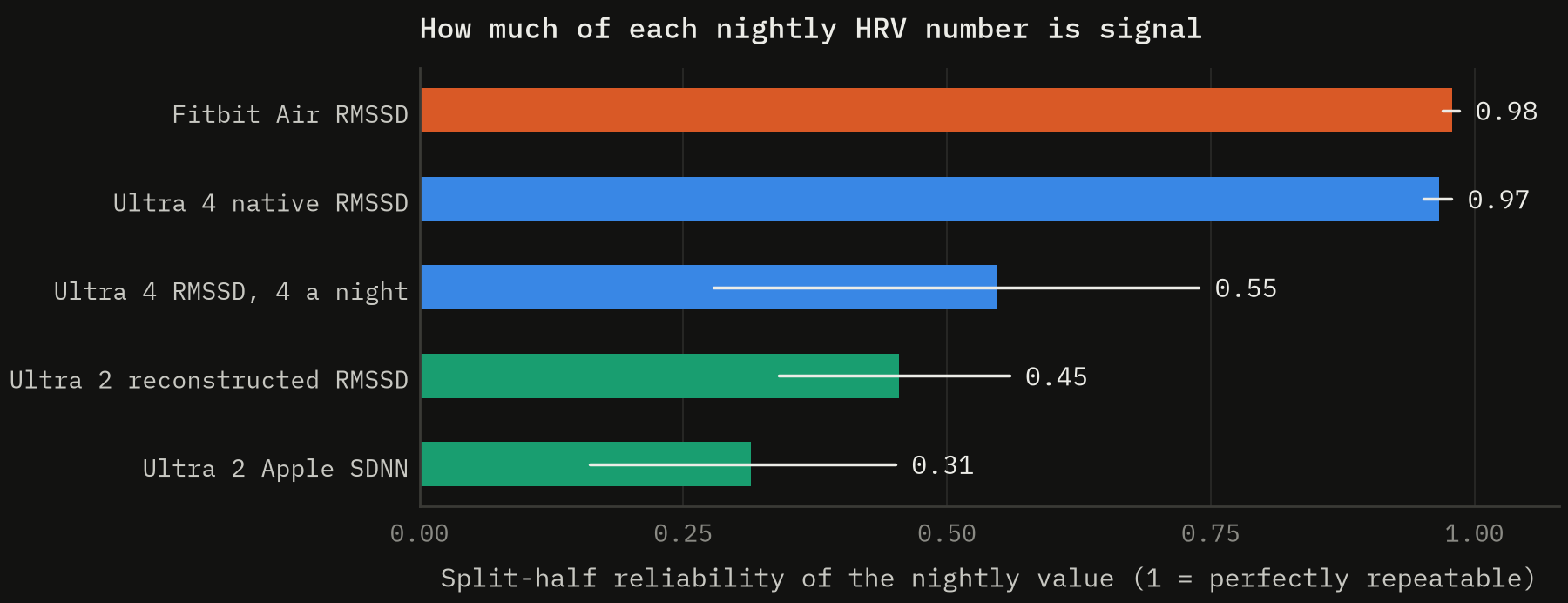
Reliability asks how much of a nightly number would come out the same if the device had happened to sample different moments of the same night. For the Ultra 2's published SDNN it is 0.31, so about two thirds of what moved from night to night was sampling noise. For the Ultra 4's native RMSSD it is 0.97.
Two noisy instruments cannot correlate above the square root of the product of their reliabilities. That puts ceilings of 0.56, 0.67 and 0.97 on the three Watch metrics. The measured values were 0.54, 0.69 and 0.94. Each one is at its ceiling, which means no smoothing or calibration could have rescued the Ultra 2's numbers. The information was not collected.
This also settles a question from my August note. On the Ultra 2, mean heart rate in non-REM sleep tracked the Fitbit's HRV better than the Watch's own HRV did, because heart rate was sampled so much more often. With twice the nights that still holds: 0.89 for heart rate against 0.69 for HRV. On the Ultra 4 the order reverses, 0.78 against 0.94. Given enough readings, HRV is the better measure of itself.
2.5 Sleep
| Watch minus Fitbit, minutes | Ultra 2 (n = 89) | Ultra 4 (n = 48) |
|---|---|---|
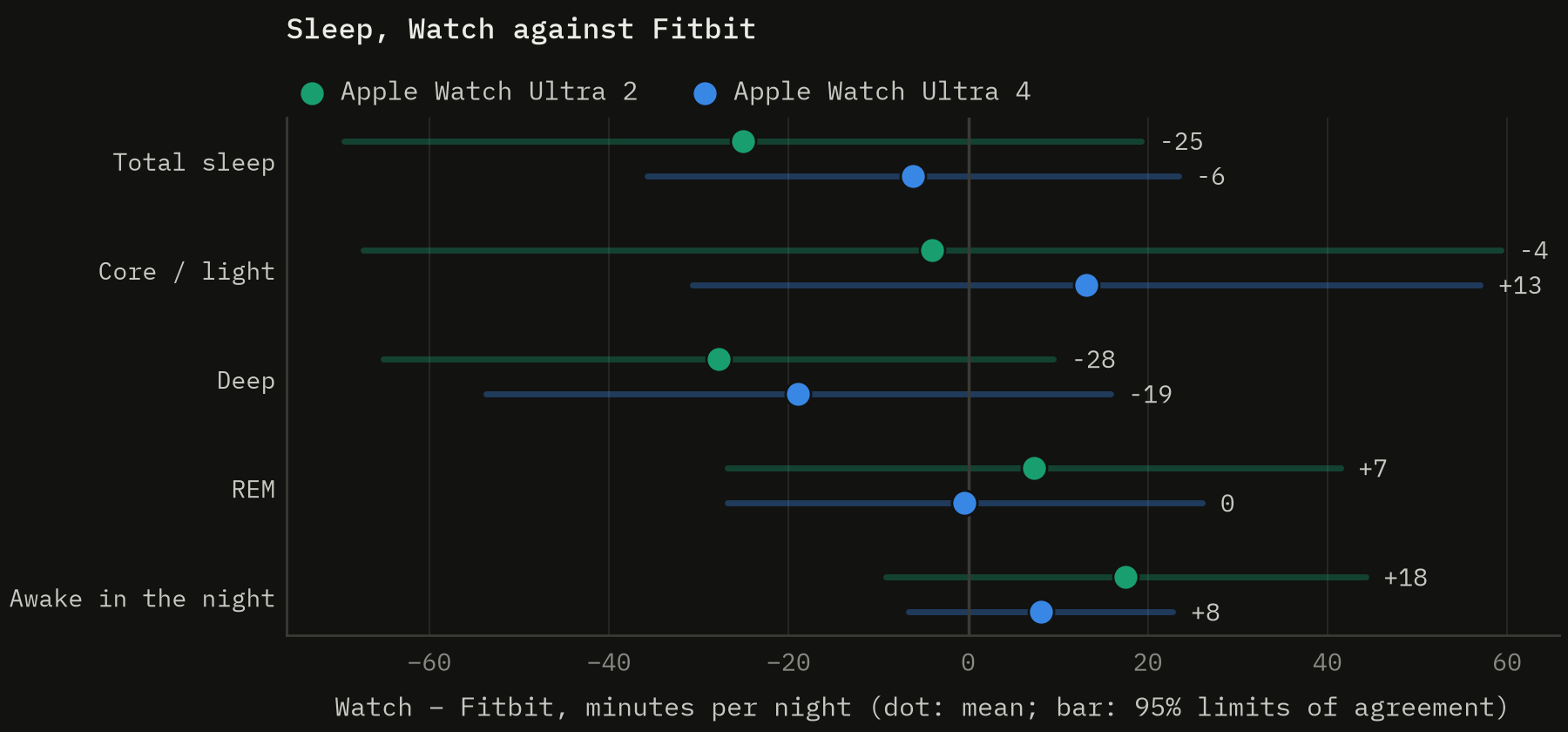
| Total sleep | −25 (−70 to +19) | −6 (−36 to +23) |
| Core / light | −4 (−67 to +59) | +13 (−31 to +57) |
| Deep | −28 (−65 to +10) | −19 (−54 to +16) |
| REM | +7 (−27 to +41) | 0 (−27 to +26) |
| Awake during the night | +18 (−9 to +44) | +8 (−7 to +23) |
Mean difference, with 95% limits of agreement in brackets. Stage rows for the Ultra 2 use 85 nights; on four nights the Fitbit recorded no stages.
The devices agree well on when sleep starts and ends. With the Ultra 4, the two wake times are within ten minutes of each other on 90% of nights, and total sleep correlates at 0.96.
The Ultra 2 scored 18 more minutes awake during the night than the Fitbit did, and so 25 fewer minutes asleep. With the Ultra 4 that gap is 6 minutes. For a while two different apps were writing the Fitbit's nights into Apple Health, so I checked whether that explained the change. It does not: the gap is the same size under either writer within each period.
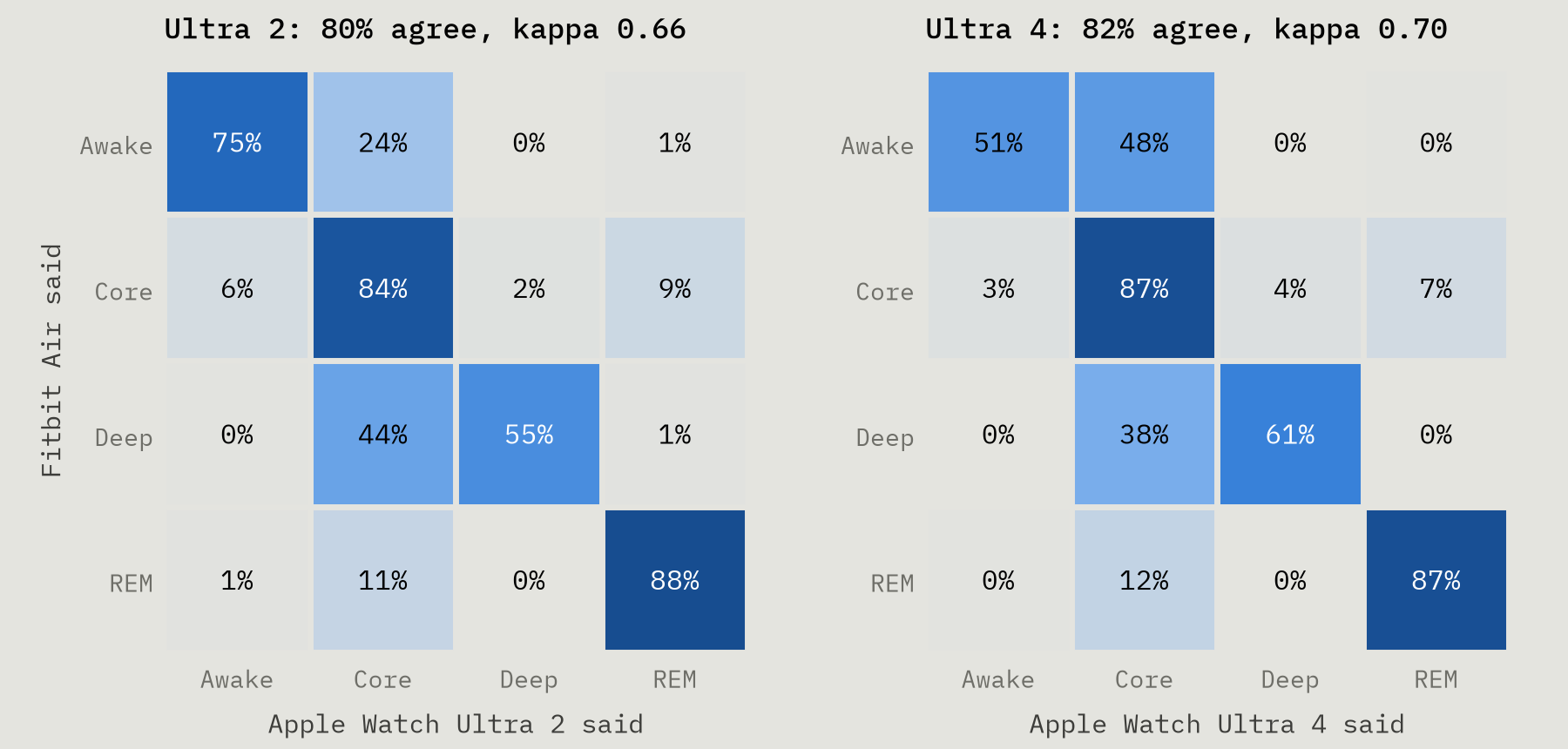
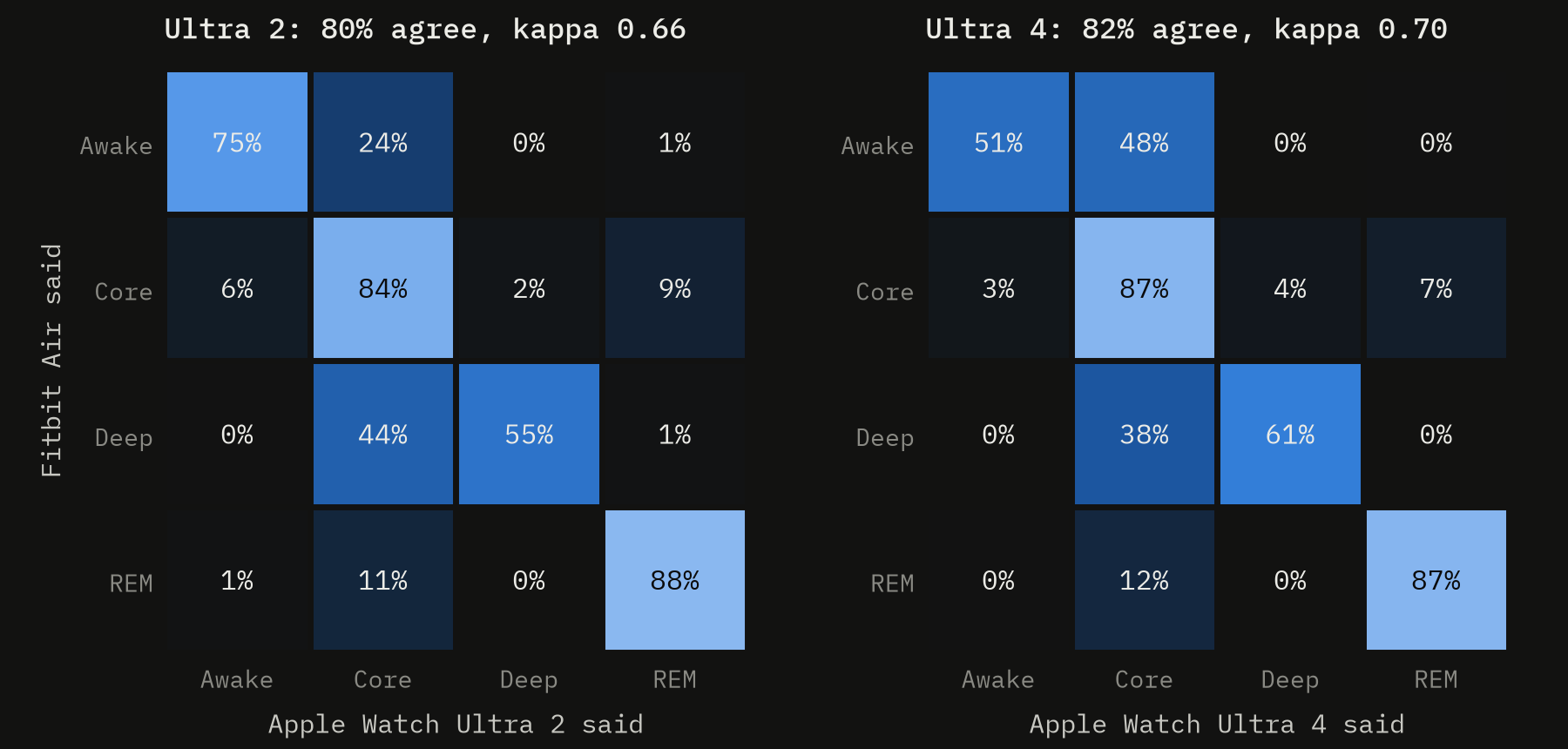
Epoch by epoch, the devices give the same stage 80% of the time with the Ultra 2 (82,046 epochs, Cohen's κ = 0.66) and 82% with the Ultra 4 (45,797 epochs, κ = 0.70). They agree on REM. They disagree on deep sleep: the Fitbit reports about 75 minutes a night and the Watch about 50, and roughly 40% of what the Fitbit calls deep the Watch calls core. Night to night, the two deep-sleep totals barely track each other (ρ = 0.11 with the Ultra 2, 0.41 with the Ultra 4).
Without a sleep lab I cannot say which is right. What the data does say is that a deep-sleep total from either device should not be compared with one from the other.
2.6 Heart rate and the other vitals
| Metric | Nights | ρ | Watch − Fitbit | 95% limits |
|---|---|---|---|---|
| Mean sleeping HR (bpm) | 106 | 0.98 | −1.1 | −1.8 to −0.3 |
| Lowest 10 min (bpm) | 106 | 0.92 | −1.3 | −2.9 to +0.2 |
| Breathing rate (/min) | 112 | 0.70 | +0.7 | −0.1 to +1.6 |
| Blood oxygen (points) | 133 | 0.34 | −0.5 | −4.0 to +3.1 |
| Daily resting HR (bpm) | 130 | 0.29 | −2.6 | −12.3 to +7.1 |
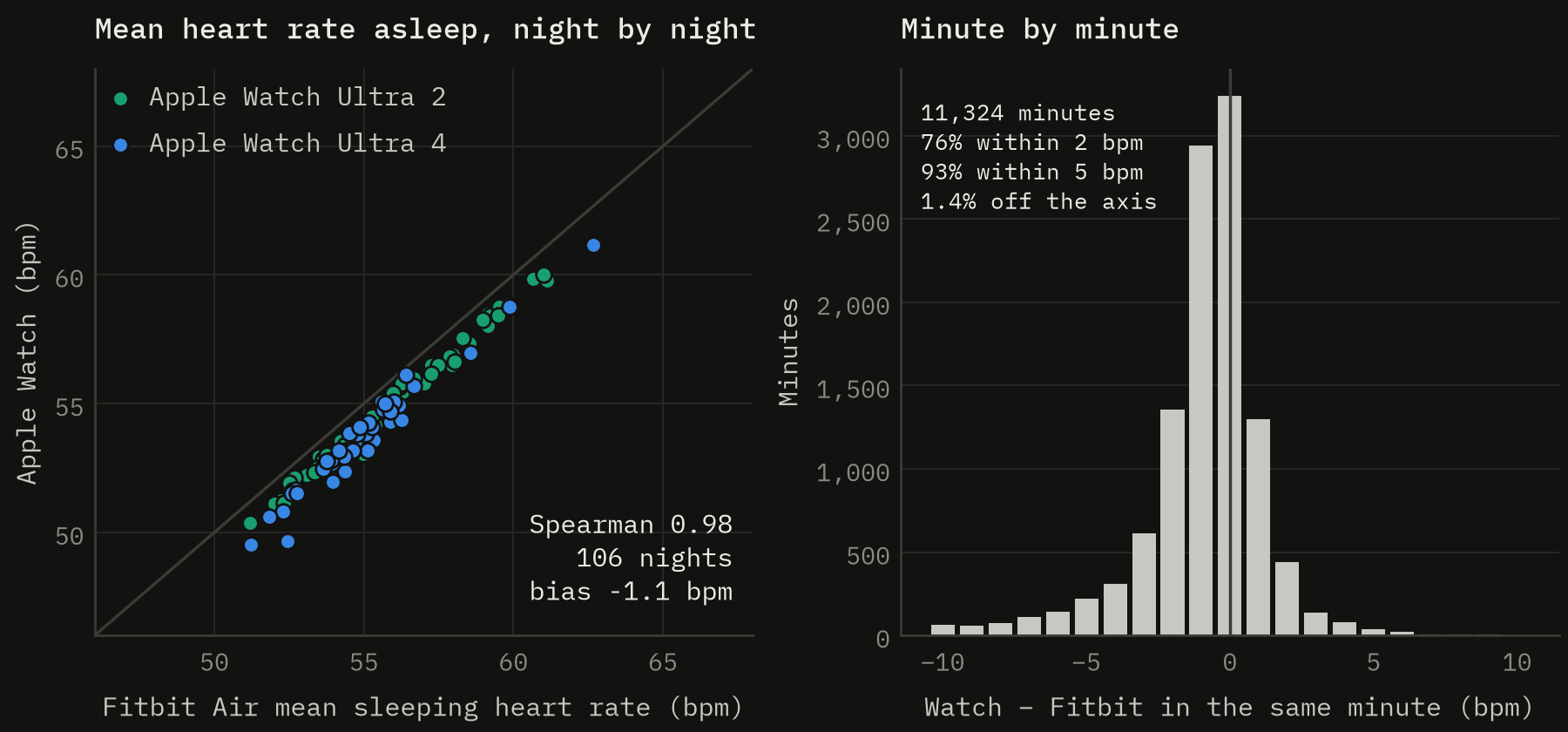
Heart rate is the easy case. Minute by minute, over 11,324 shared minutes, the two devices are within 2 bpm of each other 76% of the time and within 5 bpm 93% of the time. The Watch reads about 1 bpm lower, on both generations.
Resting heart rate is the odd one. Each company publishes a daily "resting heart rate" and the two barely correlate, although the underlying heart-rate data agrees almost perfectly. The definitions differ, and Apple's is taken from quiet waking periods across the day. The two numbers share a name and measure different things.
3. Airlift, the app that made this possible
The Fitbit Air is a small screenless band that I wear mostly for sleep. When I got it in June, its data lived in Google's health ecosystem and did not reach Apple Health at all. Every other piece of health data I have goes through Apple Health, so the Air's sleep was stranded in a second app.
Google's new Google Health API was in pre-release and could read that data. Most of the existing Fitbit-to-Health sync apps route your data through their own servers. I wanted one that didn't, so I wrote it.
Three decisions shaped it:
- On the device only. The app signs in to Google with OAuth and PKCE, keeps the refresh token in the iPhone's Keychain, and talks to Google and to HealthKit directly. There is no backend, no analytics and no iCloud. It asks for three read-only scopes.
- Review before writing. Writing bad data into someone's health record is hard to undo. Every night and every batch of readings is checked against what Apple Health already holds before it is written. Anything that fails a check waits in a queue for me to approve, and there is a mode where nothing is written without a tap.
- Safe to run twice. Each sample is keyed on Google's data-point ID, so a repeated sync writes nothing new. If Google edits a night after the fact, Airlift notices the changed content and rewrites that night.
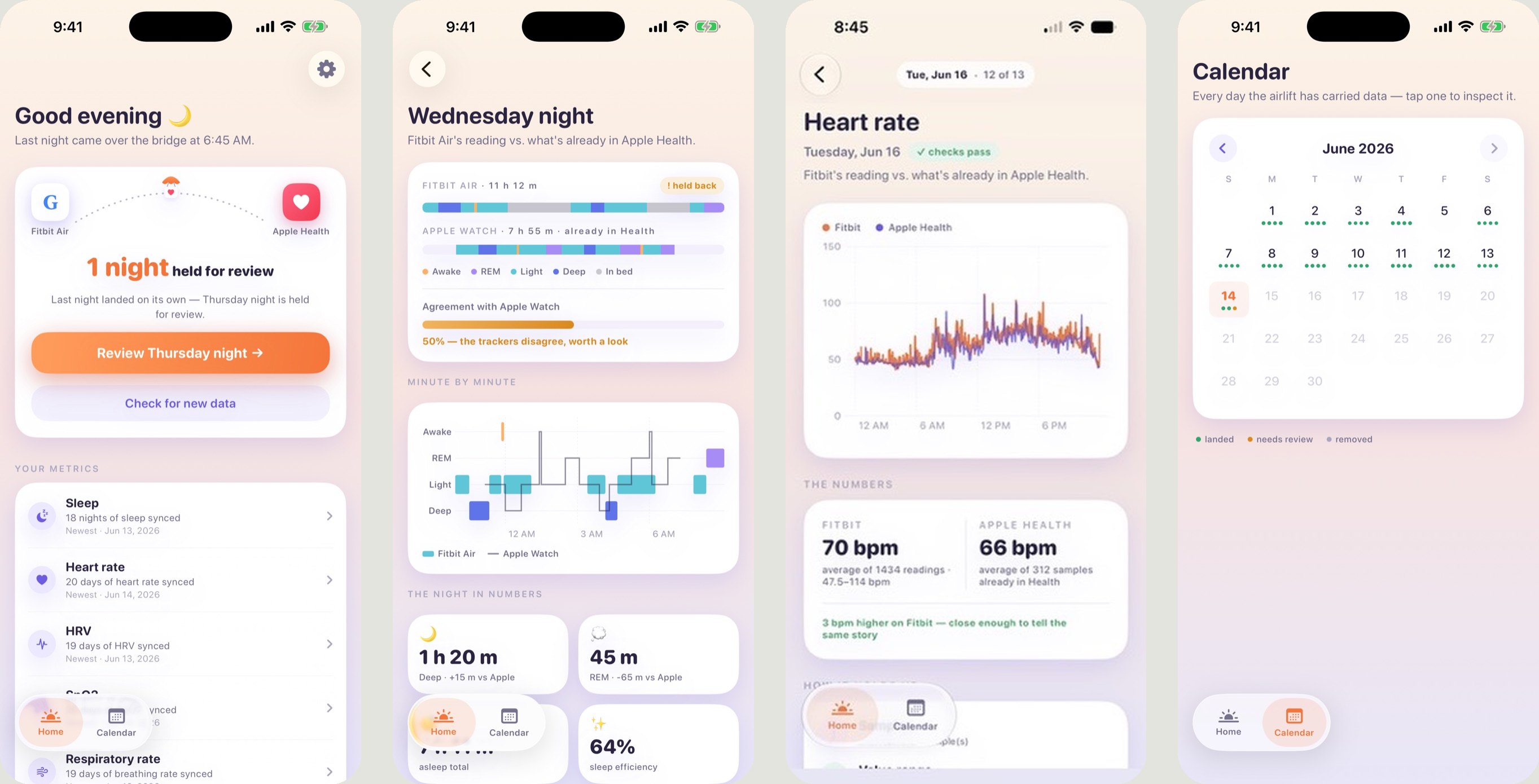
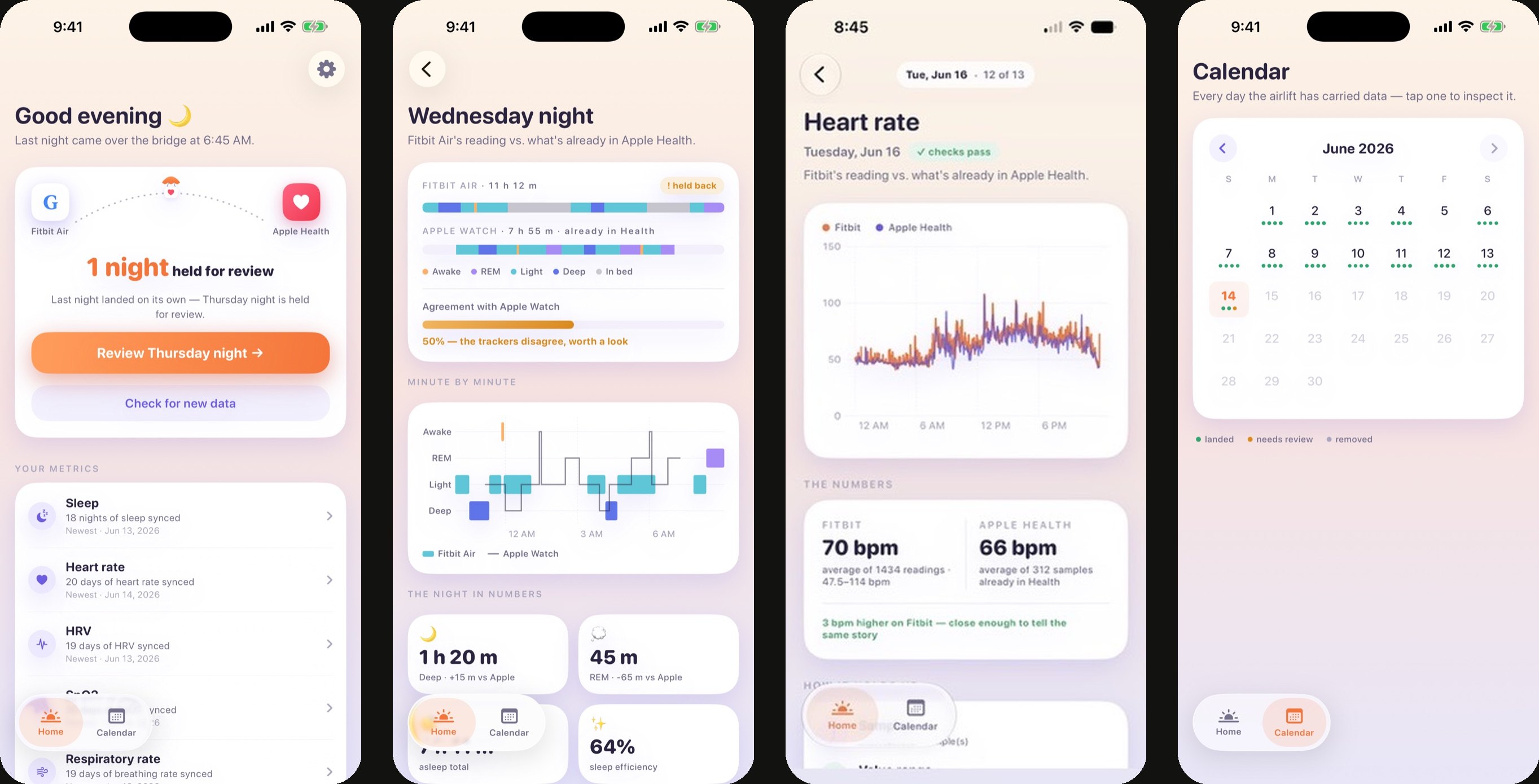
Today it is about 19,000 lines of Swift with about 320 tests. The source is at github.com/santekotturi/airlift.
The ground moved three times
August: Google shipped most of it. Google Health 5.05 began writing sleep, heart rate, steps, SpO₂ and more into Apple Health itself. It left out one thing, HRV. Fitbit reports HRV as RMSSD, and at the time Apple Health's only HRV type was SDNN, a different statistic. Airlift changed its default to syncing HRV alone, and learned to detect nights Google had already written so nothing was imported twice.
September: the Ultra 4. watchOS 27 on the Ultra 4 added a native RMSSD type and started recording it every five minutes during sleep. Until then my Apple Watch took a one-minute HRV spot check every two hours. Airlift moved the Fitbit's HRV out of the SDNN type, where it had never belonged, into RMSSD. For the first time the two devices were reporting the same statistic at the same cadence.
October: working out what each app displays. Apple shows one HRV number per night, but that number is not stored anywhere in Apple Health. To show it next to Fitbit's, I had to work out how it is computed. I typed in the numbers the app displayed for 24 nights and scored about 34,000 candidate recipes against them: which window, which readings, which sleep stages, which average. The plain mean of every reading that ends inside the Watch's sleep session matched Apple's number to the whole millisecond on 22 of 24 nights. Fitbit's nightly number needed no such work, because the Google Health API returns it directly.
What the app does with these results
- It syncs HRV and leaves the rest to Google. HRV is the one thing Google Health does not write to Apple Health, so it is the one thing Airlift bridges by default.
- It shows the offset, not the raw gap. A Watch reading 15 ms above the Fitbit is normal for me. The Compare screen states the usual gap and flags only the nights that break from it. Three of the 48 Ultra 4 nights sat more than two standard deviations from the usual ratio.
- It compares like with like. On an Ultra 4 the app sets Fitbit RMSSD next to Watch RMSSD. For Ultra 2 nights it compares against SDNN and names the statistic on each side, because the two are not interchangeable.
- It compares sleep stage by stage. The sleep screen shows each stage for both devices night by night, and both hypnograms for a single night, because one total hides where they differ.
4. Limitations
- One person. Every number describes my wrists. The offset between the devices, in particular, may be different for someone else.
- No ground truth. There was no ECG and no sleep lab. High agreement shows the devices are consistent with each other. It does not show that either is correct, and the 28% HRV offset says nothing about which one is closer to the truth.
- Hardware and software changed together. The Ultra 4 arrived with a new sensor, a new sampling schedule and a new watchOS release. The thinning test isolates the schedule for HRV. For sleep, I cannot separate the watch from the software.
- The periods are different seasons. The Ultra 2 nights are summer and the Ultra 4 nights are autumn. The Fitbit's level was stable across both, which argues against a large seasonal effect, but does not rule one out.
- The Fitbit record has gaps. Apple Health has no Fitbit data for the 13 nights up to and including the watch swap, and 14 of the Ultra 2 nights have Fitbit sleep but no Fitbit HRV.
- Thinning at random is kinder than a real schedule. A watch that samples only when the wrist is still does not see a random sample of the night.
- 48 nights is still a small sample. The interval on the headline correlation is 0.90 to 0.97. The sleep-stage differences between the two watches are smaller than their limits of agreement and should be read as tentative.
5. Conclusions
- If you are comparing an older Apple Watch's HRV with anything else, most of the disagreement is the Watch's four readings a night. Rebuilding RMSSD from the stored heartbeats helps, and stops helping at about ρ = 0.7.
- The Ultra 4's nightly RMSSD and the Fitbit Air's are, for tracking purposes, the same signal with a constant multiplier between them. Either can be followed over time. Their absolute numbers cannot be mixed.
- Sleep and wake times, total sleep and REM agree well between the two. Deep sleep does not.
- Sleeping heart rate agrees to about 1 bpm.
Should you add a Fitbit Air?
On an Ultra 2, a Series 11 or anything earlier: yes, if you care about HRV. These watches check HRV about four times a night, and the nightly number that comes out is mostly sampling noise. A Fitbit Air measures every five minutes and its nightly number is repeatable (0.98 against 0.31). Google Health does not pass HRV on to Apple Health, so you need a bridge such as Airlift to get it there.
Once the Fitbit is doing the night shift, the older Watch does not need to come to bed. The Fitbit covers sleep, heart rate, breathing rate and blood oxygen as well, and sleeping heart rate agreed with the Watch to about 1 bpm. The Watch can charge overnight. What you give up is what only the Watch records at night, such as wrist temperature.
On an Ultra 4 or a Series 12: no. The watch now measures as often as the Fitbit and tracks it at ρ = 0.94. For following your HRV over time, the second device tells you nothing the watch doesn't.
Two cautions. I measured an Ultra 2 and an Ultra 4, on one person. The Series 11 has the same heart sensor as the Ultra 2 and the Series 12 the same as the Ultra 4, so I expect the same results on those, but I have not worn them. And this is about HRV: heart rate was already fine on the Ultra 2, and on deep sleep the two devices still disagree without my being able to say which is right.
I built Airlift to have my sleep data in one place. Having it there is also what made this comparison a one-export job.
References
- Apple. Using Apple Watch to measure heart rate, calorimetry, and activity. November 2024. PDF
- Bland JM, Altman DG. "Statistical methods for assessing agreement between two methods of clinical measurement." Lancet 1986;327:307–10.
- Task Force of the European Society of Cardiology and the North American Society of Pacing and Electrophysiology. "Heart rate variability: standards of measurement, physiological interpretation, and clinical use." Circulation 1996;93:1043–65.
- Malik M, Farrell T, Cripps T, Camm AJ. "Heart rate variability in relation to prognosis after myocardial infarction: selection of optimal processing techniques." Eur Heart J 1989;10:1060–74.
- Herzig D, Eser P, Omlin X, Riener R, Wilhelm M, Achermann P. "Reproducibility of Heart Rate Variability Is Parameter and Sleep Stage Dependent." Front Physiol 2018;8:1100. doi:10.3389/fphys.2017.01100
- Kotturi S. "Sampling density, not signal quality, limits Apple Watch recovery metrics." August 2026. In the Airlift repository